 Alibaba.shop


Multi-V Die Guide: How 4V Press Brake Dies Work and How to Choose
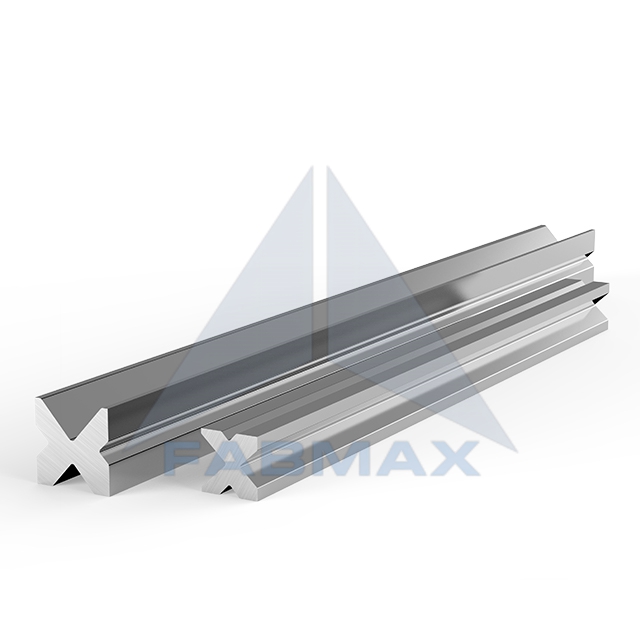
A 4V die, also called a multi-V die or 4-way die, is a press brake lower tool with four V-openings machined into a single block, one on each face. Instead of storing and swapping separate dies for every sheet thickness, the operator simply rotates the block to bring the right V-opening to the top. For job shops bending a wide mix of thicknesses on one machine, it is one of the most cost-effective dies you can own.
This guide explains how a multi-V die works, how to choose V-opening sizes, where it beats 1V and 2V dies, and what to check before you order.
How a 4V Multi-V Die Works
Looking at the end of a 4V die, you see a cross-shaped profile: four V-grooves, each with a different opening width. The die sits in a die holder on the press brake bed. During air bending, the punch pushes the sheet into the V-opening facing up, and the width of that opening controls the bend radius, the tonnage needed and the shortest flange you can form.
When the next job uses a different thickness, the operator lifts the die, turns it to the face with the matching opening and clamps it again. No extra tools come out of the rack, and no new die has to be found, aligned and shimmed.
4V Die vs. 1V and 2V Dies
| Die type | V-openings per block | Best for |
|---|---|---|
| 1V die | 1 | High-volume runs of one thickness; segmented setups |
| 2V die | 2 | Two common thicknesses with quick changeover |
| Multi-V (4V) die | Up to 4 | Job shops with mixed thicknesses, small batches and limited tool budget |
The trade-off: a 4V block is heavier than a single-V die, and you can only use one opening at a time. On long beds or very heavy plate, single-V or segmented dies can be easier to handle.
How to Choose V-Opening Sizes
For air bending mild steel, the common rule of thumb is a V-opening of about 6 to 10 times the material thickness, with 8× as the usual starting point. Thicker or harder materials such as stainless steel usually need the upper end of that range.
| Sheet thickness (mild steel) | Typical V-opening |
|---|---|
| 0.8 mm (0.031″) | 6 mm (0.236″) |
| 1.0 mm (0.039″) | 8 mm (0.315″) |
| 1.5 mm (0.059″) | 12 mm (0.472″) |
| 2.0 mm (0.079″) | 16 mm (0.630″) |
| 3.0 mm (0.118″) | 24–25 mm (0.945″–0.984″) |
| 4.0 mm (0.157″) | 32 mm (1.260″) |
| 6.0 mm (0.236″) | 50 mm (1.968″) |
A practical approach: list the thicknesses that make up most of your work, then choose a 4V block whose four openings cover them. Two blocks with neighbouring ranges, for example one for thin sheet and one for medium plate, will cover most job-shop work.
Also keep in mind:
- Inside radius: in air bending, the inside radius of mild steel comes out at roughly 1/6 of the V-opening.
- Minimum flange: a wider V needs a longer flange. If the flange is too short, it falls into the V.
- Tonnage: a narrower V needs more force. Always check the bending force chart and the die's maximum allowable load.
What to Check Before Ordering a Multi-V Die
- Die holder and clamping: confirm the block size fits your die holder and lower beam.
- Die angle: 85°–88° for general 90° air bending, or acute angles if you overbend for springback.
- Length: a full-length block or sectioned pieces, depending on your bed length and how much handling the operator can manage.
- Material and hardening: hardened, precision-ground alloy tool steel keeps the V-shoulders sharp and the angles consistent over long runs.
- Matching punch: the punch tip radius and angle must suit the smallest V you plan to use. See our press brake punches.
See Fabmax Tooling in Person at JIMTOF 2026
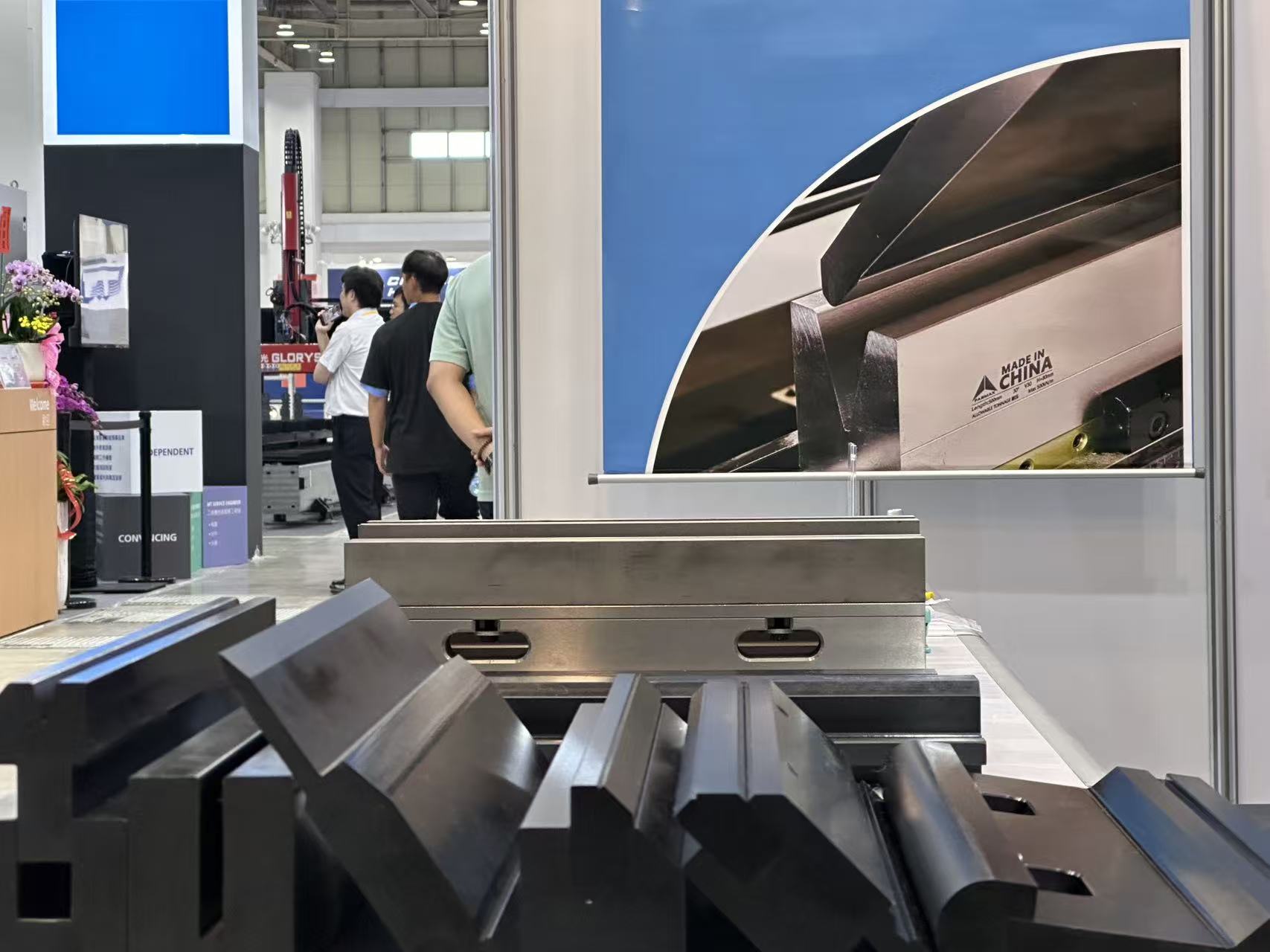
At trade shows, visitors pick up and inspect our punches and dies side by side, checking the surface finish, the V-shoulder geometry and the markings on each tool. Our next stop is JIMTOF 2026 in Tokyo (26–31 October), booth E1040, East Hall 1, Tokyo Big Sight. Bring your machine model and the thicknesses you bend most, and our team will help you put together a die set. See all our upcoming events.
FAQ
What is a 4V die used for?
A 4V die is used on press brakes to bend sheet metal of different thicknesses with one tool. Each face has a different V-opening, so the operator rotates the die instead of changing it.
Is a multi-V die the same as a 4V die?
Mostly, yes. "Multi-V" covers any die with more than one opening, usually two to four. A 4V die is the most common multi-V design.
What V-opening do I need for 2 mm steel?
For 2 mm mild steel, a 16 mm V-opening (8× thickness) is the usual starting point. Use 12 mm for a tighter radius, or 20 mm for lower tonnage.
Can a 4V die bend stainless steel?
Yes. Choose a wider V-opening than you would for mild steel of the same thickness, because stainless steel needs more force and springs back more.
Does Fabmax make custom multi-V dies?
Send us your machine model, die holder type and the V-openings you need through our contact form, and our engineers will recommend a standard or custom solution.
New to press brake tooling? Start with our complete guide to press brake tools.
Fabmax has manufactured press brake tooling in Maanshan, China since 1995. Our Multi-V dies are available with up to four V-openings, from 6 mm (0.236″) to 50 mm (1.968″), alongside 1V, 2V and T-style dies, TRUMPF®/WILA®-style tooling and crowning systems.
View Multi-V Dies Get a Quote