Call Us Today!
Industry News

Mastering the Bend: What are the 3 Crucial Tooling Factors Affecting Accuracy?

Views : 156
Author : Bill Hu
Update time : 2025-12-30 16:10:39
V-Die Opening (V-Width):
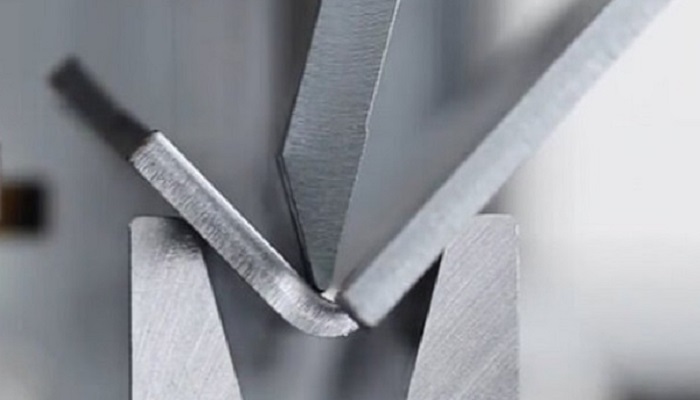
The width of the V-opening in your lower die is arguably the single most critical factor for accuracy, especially in air bending.
 
Impact on Accuracy:
The V-opening dictates the lever arm over which the material bends. If the V-width is too small for the material thickness (T), the required tonnage increases drastically, potentially damaging the tooling and stressing the machine. If it's too large, the bend radius becomes excessively large, making the bend angle difficult to control and increasing the effect of springback.

The 8x Rule (General Guideline):
For mild steel, the industry standard suggests that the V-opening width (W) should be approximately 8 times the material thickness (T).
W ≈8*T
 
Optimal Result:
Using the correct V-width helps control the inner bend radius (R inner), which is vital for calculating the bend deduction and ensuring the final part dimensions are correct.


Punch Tip Radius (R punch):
The radius of the punch tip has a direct influence on the radius formed on the inside of the bend.

Impact on Accuracy:
The inner radius of the bend determines how much the material stretches and influences the overall neutral axis of the metal.

Small Radius (Sharp Punch):
If the punch radius is too small (e.g., less than 0.5*T), it can create excessive stress and cause the material to fracture or "coin" locally, even if you are aiming for air bending. This makes the bend less predictable.

Correct Radius:
For optimal results in air bending, the naturally formed inner radius (R formed) is typically around 1.2 to 1.5 times the material thickness. Choosing a punch that complements this natural radius (or is slightly smaller) provides the most stable and repeatable bend.
 
Tooling Wear:
A consistent punch radius is essential. A worn, rounded, or chipped punch will produce inconsistent inner radii, leading to inaccurate angle readings and difficulty in repeating bends.


Tooling Alignment and Flatness (Shoulder Condition):
This factor relates to the physical condition and setup of the bending dies.

Impact on Accuracy:
Both the punch and the die must be perfectly straight and parallel to the press brake bed and ram, respectively.
 
Parallelism:
Any misalignment (known as "tooling lean") across the length of the tooling will result in an inconsistent bend angle along the part—one end might be 90°while the other is 92°.

Shoulder Wear:
The shoulders (the top flat surfaces) of the V-die must be flat and sharp. If the shoulders are rounded or indented from previous use, the sheet metal will not rest consistently, causing the material to slip slightly or bend unevenly at the start of the forming process. This drastically compromises bend repeatability.

Maintenance:
Regular tooling maintenance and inspection are required to ensure the working surfaces are clean and damage-free.

Press brake tooling